
Shared Frameworks for Regional Cross-Sector Collaboration
Practical, learning-oriented frameworks designed to support regional partnerships striving to strengthen high school–to–postsecondary transitions.
About the Tools:
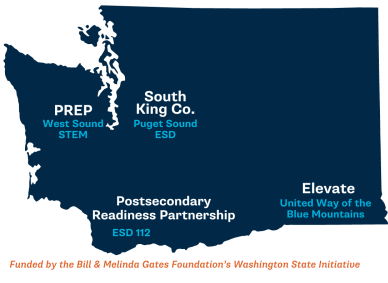
Horizons partnerships reflect a statewide effort to strengthen high school–to–postsecondary transitions through regional, cross-sector collaboration, grounded in local context and evidence-based solutions.
Supported by the Gates Foundation, this effort connects four regional partnerships across Washington State that bring together K–12 districts, higher education institutions, and community-based organizations to address shared barriers to postsecondary access and success. Through this network, regional teams share practices, analyze data, and collaborate on strategies to strengthen postsecondary transitions. The initiative also provides enabling supports—including technical assistance, shared data infrastructure, and structured opportunities for reflection—to help partnerships learn from one another and address challenges that no single organization could solve alone.
As partnerships began to engage in deeper cross-sector collaboration, a shared need emerged for clear, practical frameworks that could help regions reflect on building capacity without turning that reflection into compliance. Rather than evaluating performance, partnerships needed structured ways to track learning and growth, and to understand how their collective capacity was evolving relative to their own starting points.
The Horizons frameworks were developed to meet this need. Together, they provide a shared, learning-oriented language for understanding partnership design, backbone function, and data capacity—while intentionally preserving space for regional context, interpretation, and dialogue.
For this reason, the Horizons frameworks and accompanying facilitator guidance are offered as shared resources. They are designed to be used, adapted, and extended by others interested in launching or strengthening regional, cross-sector collaboration in service of improved high school–to–postsecondary transitions—providing practical structures to support partnership learning, capacity-building, and ongoing improvement.
Explore the frameworks to see how they might support regional collaboration in your context. If you’re interested in discussing this work further, we invite you to connect with us.
The Backbone Capacity Framework helps partnerships examine how the backbone organization supports coordination and shared work across the region. It centers on day-to-day partnership operations, driving collective action, and managing shared learning—providing a practical way to reflect on how backbone roles support sustained collaboration.
The Effective Partnership Framework helps regional partnerships reflect on how they work together to improve high school–to–postsecondary transitions. It focuses on shared purpose, partner participation, enabling conditions, and growth over time, offering a clear structure for conversation, alignment, and learning across cross-sector partners.
The Data Literacy, Capacity, and Use Framework helps partnerships reflect on how data is understood and used to support decision-making. It focuses on shared data practices, ethical and responsible data use, and the systems that support data work—helping partners build a common understanding of how data informs learning and coordination across the region.
The Facilitator’s Guide provides general guidance for using the Horizons frameworks through structured reflection and group dialogue. The guidance is designed to support individual reflection, shared understanding, and productive conversation across partners, drawing on lessons from prior use to support effective and inclusive facilitation.
A recommended approach is provided, with flexibility to adapt the process to fit regional context and partnership dynamics. Facilitators are encouraged to use their professional judgment and understanding of local conditions to support broad participation and meaningful insight.
Facilitator’s Guide
Sign up to download a copy of this guide.
These tools were designed to help partnerships understand how they work together, where they are strong, and where they may want to grow. They are not performance evaluations; they are reflective tools that support learning, planning, and continuous improvement.
How You Can Use These Frameworks in Your Region:
Facilitate structured reflection to support shared sensemaking and dialogue across partners
Support individual and collective reflection on how partnership work is currently organized and experienced
Surface focus areas for collaboration through guided discussion grounded in regional context
Inform regional planning and coordination by clarifying shared priorities and roles
Strengthen alignment across education sectors in support of improved high school–to–postsecondary transitions
Public Dissemination: We introduced these assessments at WERA 2025 during the session Learning Across the Gaps: Using Data to Strengthen Regional Collaboration and Capacity in Uncertain Times. All three assessments are available as free, public tools for any region working to strengthen post-secondary transitions, along with a facilitation guide to support their use.